
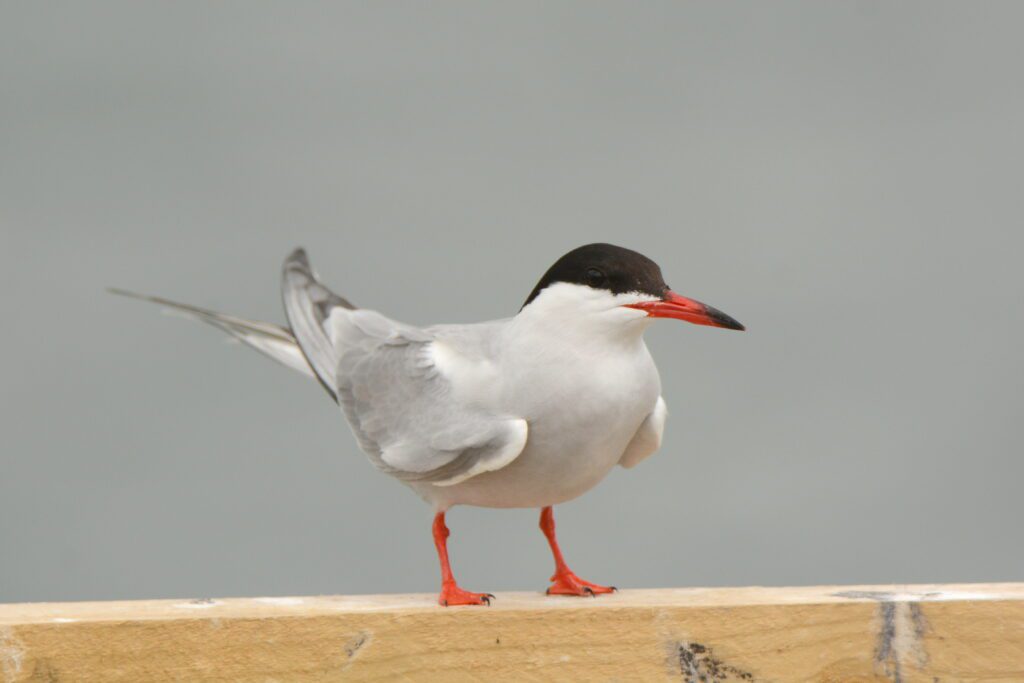
We get to see some incredible migratory species in Ireland, some of which fly tens of thousands of miles to be here. For Common Terns, their migratory path takes them from Ireland to West Africa and back each year, racking up about 16,000 km round trip. But once the journey is complete, that doesn’t mean their flying time is over.
When the terns come back to our shores in the summer, they travel out to sea each day to forage for food for themselves and their young chicks. Up until now, it’s relatively unknown where some of these species are foraging. Now, with gps tracking, we can expand the areas we consider important for seabirds by scientifically-backed data.
 Our Work at Dublin Port
 Our Work at Dublin Port
During the 2026 summer seabird breeding season, our Dublin Bay Birds Project team was able to tag 25 Common Terns at the Dublin Port colony to track their comings and goings. Thanks to support from ESB and Dublin Port, the terns were fitted with a light-weight tag that is completely safe for the bird and allowed our teams to track their movements for up to a month.
Each tag recorded the exact location of the bird every five minutes throughout the day. When the tagged birds returned to the colony, the data downloaded to a special device placed in the colony. The gps data essentially provides a detailed chronicle of exactly where the birds went any time they left their nest.
Why We Track
Tracking technology is huge for helping us understand our seabirds, and as the technology advances, devices become smaller meaning we can use them on smaller species such as terns. Some researchers have used tracking devices to learn exactly how and where birds migrate. In our case, the gps tracking allowed us to find out more about where our terns go while they are in Ireland. The fine-scale precision that gps technology provides can reliably fill gaps in knowledge about where birds feed, how consistently they visit the same places, and how that might change from day to day, week to week, or depending on factors such as tides and weather.
Up to now we have been protecting the birds in their colonies, but this research will help us go an extra step to protect the important feeding grounds and food sources that are critical to their success.
This GPS tracking work was made possible through the ESB Sustainability Fund, and through the continued support from Dublin Port.
We are very grateful to Dr. Mark Jessopp and Astrid Dedieu of University College Cork for their crucial assistance in fitting the devices to the birds, and for their essential advice and support throughout the planning and deployment phase.
All ringing and GPS tagging was carried out under BTO and NPWS licenses, by trained ornithologists observing strict protocols.