
In September 2024, we lost a family member of BirdWatch Ireland, Steve Wing. To honour our friend and colleague, the bursary at Cape Clear Bird Observatory has been named after him to preserve his legacy. The Steve Wing Memorial Bursary is designed to help with support training, mentorship and direct experience in the fields of ornithology and ecology. For 2026, Tim Slattery was awarded as the recipient. Read about his experience at the Cape Clear Bird Observatory below.
2026 Steve Wing Bursary Recipient, Tim Slattery
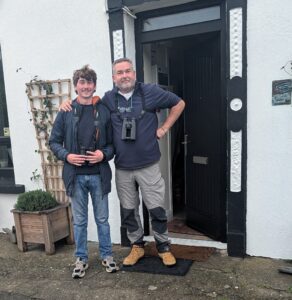 Cape Clear is a truly special island for birding, particularly during the autumn migration season. As a young birder and recent graduate of UCC with a BSc in Ecology and Environmental Biology, the opportunity to become the second recipient of the Steve Wing Memorial Bursary came at the perfect time and is one I am extremely grateful for!
Based in south Kilkenny and having spent the past four years studying in Cork, I have gained valuable birding experience through outings organised by the Carlow, Waterford and Cork branches of BirdWatch Ireland. When applying for the bursary, I was very keen to further develop my bird identification skills, gain practical experience in mist-netting and bird ringing, become involved in other projects on the island, and learn more about the day-to-day running of Cape Clear Bird Observatory.
During my two-week stay, I was based at the observatory by the harbour. With the mentorship of Cape Clear Bird Observatory warden, John Horton, I spent much of my time participating in ringing activities at Cotter’s Garden, Nordy Wood, East Bog and Michael Vincent’s Garden, or birding around the island, mainly around the lake, bogs and between North and South Harbour.
Although I previously had opportunities to observe bird ringing, mainly involving seabirds, through fieldwork for my final-year project on Gannet behaviour at sea and also during an internship with the Port of Cork’s Common Tern breeding project in the summer of 2025, the practical aspects of bird ringing were still very new to me, particularly in relation to passerine migration.
With my bursary taking place during the final two weeks of September, I was especially excited about experiencing autumn migration on Cape Clear firsthand. These two weeks also provided an invaluable opportunity to learn from experienced ringers and birders, develop my practical skills and gain a greater appreciation of the important work carried out at Cape Clear Bird Observatory.
Throughout my stay, I was involved in regular morning ringing sessions, where I assisted by scribing for the ringers. This allowed me to become familiar with the recording of ringing data, including how different species were aged and sexed, how moult was assessed, and how measurements such as wing length and weight were recorded.
Most evenings were spent birding around the island, counting Little Grebes and Mallards on the lake, observing flocks of Linnets and Starlings along the road towards East Bog, or searching for Choughs, Skylarks and birds of prey (Sparrowhawks, Kestrels, Buzzards), across the island.
On one morning, I took part in a Rock Dove ringing session in a local garden, during which 13 Rock Doves, including nine newly ringed birds, and a Jackdaw were processed. In addition to a standard metal identification ring, each Rock Dove was fitted with a coloured Darvic ring bearing a unique two-letter code on the other leg. These colour rings allow individual birds to be identified in the field from a distance, without needing to recapture them. I followed this up on a subsequent day by carrying out a survey of colour-ringed Rock Doves around the goat farm on the island, recording their Darvic ring codes to identify which previously ringed individuals were present.
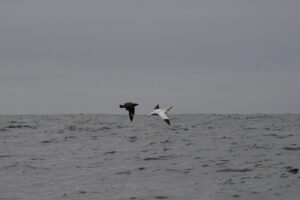 During the bursary, I was fortunate enough to join a six-hour pelagic trip beyond Fastnet Rock. With excellent conditions for observing seabirds from the boat, we were treated to fantastic views of several species, including Manx Shearwaters, Sooty Shearwaters, Cory’s Shearwaters, Great Shearwaters, Storm Petrels, Guillemots, Gannets, Puffins and Great Skuas, as well as Minke Whales.
In the evenings, I contributed to the observatory’s longstanding tradition of compiling the daily species log, which has been maintained since 1959, and took responsibility for completing it myself when the warden was away. I also assisted with the day-to-day running of the observatory by welcoming guests on their arrival at the harbour and helping to keep the accommodation clean and tidy.
During the ringing sessions, I found identifying birds in the hand to be quite different from identifying them in the field. It was interesting to learn how ringers distinguished between similar species, such as Willow Warblers and Chiffchaffs, by examining features such as the emargination of the primaries. Both species were regularly caught in the mist nets, providing valuable opportunities to become more familiar with these identification features.
Some mornings proved quite rewarding, with a Sparrowhawk ringed at Michael Vincent’s Garden on one occasion, while another morning saw a fall of Pied Flycatchers following poor weather the previous day. Another highlight was getting to see a Melodious Warbler at Michael Vincent’s Garden, a rare migrant to Ireland and one of three individuals ringed on Cape Clear during the previous couple of weeks.
John and the visiting ringers were extremely generous in sharing their knowledge and experience, and I was very fortunate to have the opportunity to handle several species, including Jackdaws, Rock Doves, Goldcrests and Blue Tits. Being able to examine birds up close helped me appreciate the level of detail involved in identifying them in the hand and gave me a new perspective on species I was already familiar with from birding in the field.
Alongside the birding and ringing activities, I thoroughly enjoyed the social aspect of staying at the bird observatory. Meeting and spending time with birders and ringers from different backgrounds was a very enjoyable part of the experience, providing plenty of opportunities to exchange knowledge, hear about others’ experiences and learn from their expertise throughout my time on Cape Clear.
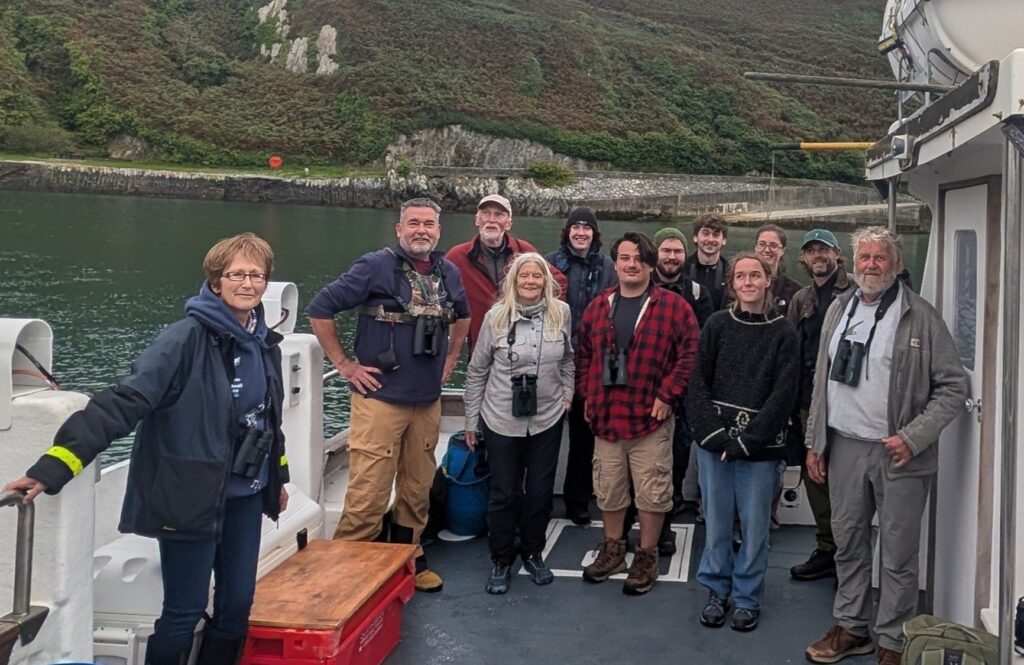
Overall, my two weeks on Cape Clear were an incredibly rewarding experience, allowing me to develop my bird identification skills, gain valuable practical experience and learn from experienced birders and ringers. My time at the observatory also gave me a much greater understanding and appreciation of the important role bird observatories play in monitoring migration, collecting long-term data and contributing to bird conservation. The experience has further encouraged my interest in ornithology, particularly bird ringing, and I am very keen to work towards obtaining a ringing licence in the future.
While I thoroughly enjoyed my two weeks on Cape Clear and gained a brief insight into island life, the time seemed to fly by! It was a very rewarding experience, and I would have loved to spend more time on the island, continuing to develop my skills in ecology in ornithology and learn more about the work of the observatory.
I would like to thank BirdWatch Ireland, Steve Wing’s family and everyone involved in organising and supporting the Steve Wing Memorial Bursary for providing me with this fantastic opportunity. I am especially grateful to John Horton, who was incredibly welcoming and accommodating throughout my stay. John was a fantastic mentor, always willing to share his knowledge and experience, and enthusiastic about helping me understand how a bird observatory is run. I am also very grateful to all the ringers, birders and others I met during my time on the island, who were extremely supportive and made my stay so enjoyable. It was a real privilege to receive this bursary in memory of Steve Wing, and I hope that it continues to provide opportunities for young birders to develop their passion for ornithology for many years to come.