Colony counts and Rookeries: Do rooks nest in your CBS square? If so, we’d like you to take a closer look…
Dr. Fionn Ó Marcaigh, CBS Project Officer in the NPWS Scientific Advice and Research Directorate
CBS transect surveys are one part of this, so if you see any rooks on your transects, record them like any other species. You can identify a rook by its uniformly dark plumage, the patch of grey skin at the base of its bill, and the feathers around its legs that resemble a pair of baggy trousers. Although they are rather plain-looking birds overall, when seen up close or at certain angles their plumage can take on a rather pretty purplish gloss. They are vocal but not particularly musical, with a voice similar to a hooded crow’s but even more croaky and dry. The way the Collins Bird Guide puts it is that hooded crows roll their Rs and rooks don’t!
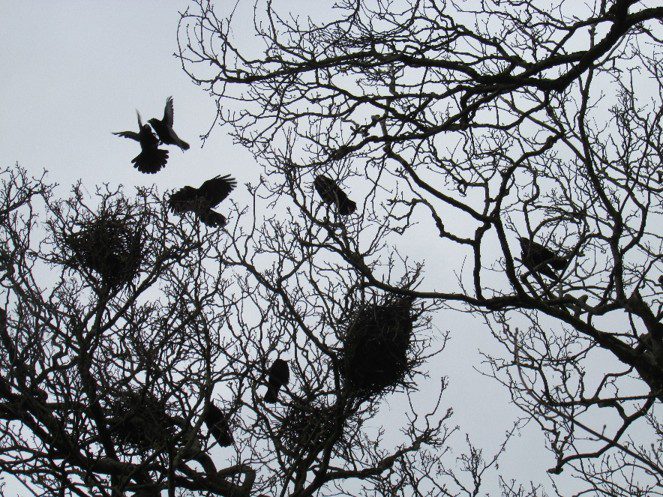
While doing your transects and exploring your square, watch out for any rookeries nearby. We are particularly interested in data on rookeries as it can tell us how the breeding population is faring. At the end of your CBS Count Summary Sheet, you will find a section for Colony Counts, where you can record nest numbers in any rookeries you find. Rookeries are often found near villages and small towns, and they can be so busy and noisy, particularly in the evening, that you may hear a rookery before you see it!
Curry Rookery by Fionn Ó Marcaigh
When you’ve found a rookery, make a count or estimate of the number of apparently occupied nests. You might find it helpful to use binoculars and look at the colony from multiple positions. You don’t need to spend too much time ascertaining whether a given nest is occupied or not, however: the overall number is what’s important. You might not be able to stop and count nests when you’re doing your main CBS transect counts, so your colony counts can be done separately from the transects and don’t have to be on the same date. You aren’t restricted to your transect routes, either: you can count colonies anywhere within your 1 km x 1 km square. CBS visits take place in the period when rooks are busy nesting, but the emerging leaves will make counting nests difficult, especially on your late visit. So if you do have a rookery in your square, consider visiting it specially and making a count before the leaves have hidden the nests. The first couple of weeks in April are often suitable.
We’re grateful for the colony counting that CBS surveyors have already undertaken. In the 2024 CBS, the largest rookeries counted were in Counties Laois and Wexford, each with 220 nests. Now we’re hoping to get more and more counts, and we’d also be glad if people who have counted rookeries previously would return and count them again each year, to show any changes over time. In a way, a rookery is like a town in itself, being built up by a community of birds over years. Rooks are industrious, clever builders, and in old Irish rookeries some nests have been measured at nearly 2 metres wide.
Our countryside provides ample food for these little societies. A 1984 National University of Ireland PhD thesis by Ron Macdonald found 66 rookeries in a 100 km2 area of Co. Kildare, containing nearly 5,000 nests. With typical corvid resourcefulness, rooks are adept at providing for themselves, and this sometimes involves a bit of pilfering of the local produce. In their 1900 book The Birds of Ireland, Ussher and Warren describe mobs of rooks walking along drills of turnips during crop thinning, pulling the plants up one by one, until they had gone through entire acres of them. In fact, the scarecrows that are put up to protect crops are largely aimed at rooks, more so than other corvids. Being so adaptable, however, I have also seen rooks foraging in quite different habitats, for example picking through small shellfish on the shore.
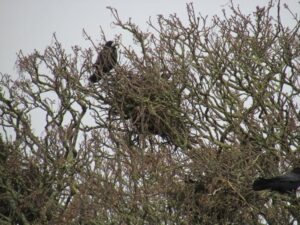
Curry Rookery by Fionn Ó Marcaigh
Conflict over crops has caused trouble for the species: as abundant as they are in Ireland, you might be surprised to learn that rooks are on the decline across Europe. In the latest European Red List of Birds published by BirdLife International in 2021, the Rook was put in the Vulnerable category, a serious change from its listing as of Least Concern in the 2015 edition, which the authors attributed to persecution. Even here in Ireland, CBS results indicate a moderate decrease in their population since 1998. This is why we are so keen to collect data on our rookeries. These birds are a quintessential part of the Irish landscape, and the data that we all provide through the CBS is an important part of understanding and protecting them.