From tagging chicks to educating island visitors, each year, over a dozen wardens join BirdWatch Ireland’s conservation team to protect and monitor Ireland’s seabirds. Meet some of our 2026 seabird wardens and learn what they do.
Portrane Little Terns: Patrick Ryan and Kiara Mulvey
The Portrane Little Tern colony has gone from strength to strength since the members of BirdWatch Ireland’s Fingal Branch took it upon themselves to volunteer thousands of hours over the last decade to protect their nests and give them a chance to nest successfully. This year we are supporting the Fingal Branch volunteers with two full-time wardens, thanks to funding from Fingal County Council and the National Parks and Wildlife Service through the Local Biodiversity Action Fund.
Patrick Ryan: “My name is Patrick, and I am one of the wardens at the Portrane Little Tern project in North County Dublin. My position involves protecting the breeding Little Terns and Ringed Plovers at Portrane beach. This is achieved through setting up two layers of protective fencing to prevent the entry of mammal predators into the main nesting area, engaging with beach users to prevent disturbance to the colony and scaring away predatory birds.
“I have just finished my undergraduate degree in Environmental Science at Ulster University. During my degree, I did a year-long placement with the Wildfowl and Wetlands Trust where I worked with Black-headed Gulls and Common Terns. I have been a keen birdwatcher and a member of BirdWatch Ireland for five years, so it is an amazing privilege to finally be able to contribute to its conservation work. In this role with BirdWatch Ireland I am really looking forward to seeing all the recently fledged Little Terns gathering around Portrane before they head off on their migration after the (hopefully very successful) breeding season.”
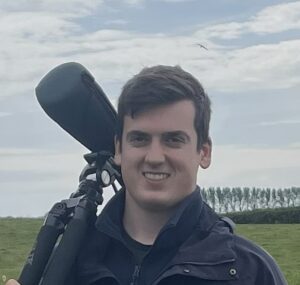 Patrick Ryan
Kiara Mulvey: “My name is Kiara Mulvey. I’m working in Portrane as a Little Tern Warden and I am also overseeing the breeding success of Ringed Plovers. I was most looking forward to seeing the chicks hatch and I’m delighted to say I have gotten to witness this over the past number of days! Next for me will be seeing them feed. My favourite seabirds are Gannets. They’re so majestic and I love how they dive into the water.”
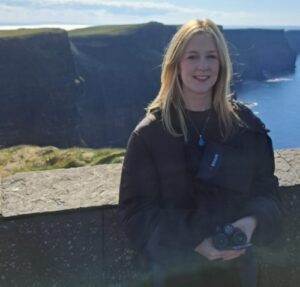 Kiara Mulvey
Kilcoole Little Terns: Chris Johnson, Matthew Doyle and Adam Nugent
The Kilcoole Little Tern project is a National Parks and Wildlife Service Project and we’re delighted to work closely with NPWS to protect and monitor what has long been Ireland’s most important Little Tern colony, in north Wicklow. Our senior warden, Chris Johnson, has worked on the project over many years, and Matthew Doyle is in his third year working at the colony. Joining them, and our team of very dedicated night wardens who defend the colony from predators, is Adam Nugent.
Adam Nugent: “My name is Adam Nugent and I’m a Wicklow-based conservationist, nature educator, and content creator exploring the ecology and folklore of Ireland. I studied Nature Animation in MTU in 2022 and completed a work placement with the National Parks and Wildlife Service where I assisted in Merlin and Bat surveys and also analysed Peregrine Falcon nest footage for the Rangers in the Wicklow Mountains National Park.
“I’m currently working as a Little Tern Warden on Kilcoole Beach, where I spend my shifts searching for new nests, deterring predators and speaking with members of the public about the project. My favourite seabird (other than the Little Tern, of course) is the Gannet. Seeing them dive is an incredible spectacle – they have a real power and a grace to them. I also love Puffins for the exact opposite reasons.
“I’m really excited to see more Little Tern chicks moseying around the beach. We’ve had a few hatch out already and they would absolutely melt your heart. Tiny little things!”
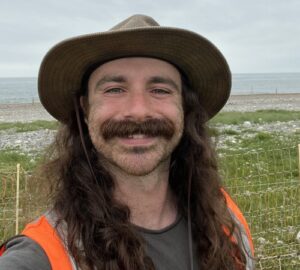 Adam Nugent
East Coast Seabird Survey: Sam Preston, Feidhlim Gralton, and Alex Fink
2026 is the third consecutive year in which we have been able comprehensively to census and monitor the cliff-nesting seabirds at six important colonies on the east coast, thanks to funding from the Phase One windfarms in the Irish Sea. Previously, this sort of monitoring has been much more sporadic, but by repeating these efforts over three successive years we can get a good insight into how these colonies are faring.
Alex Fink: “I have joined BirdWatch Ireland as a seabird fieldworker on the East Coast Seabird Monitoring Team for the third year in a row. Prior to that, I spent two seasons with the Roseate Terns on Rockabill Island. Sam, Feidhlim and I monitor seabirds at Howth Head, Bray Head, the Skerries Islands, Loughshinny and Ireland’s Eye. At these colonies, we also try to estimate breeding performance by looking closely at a subset of nests and following the journey of each of the eggs laid in these nests. We also censused all these colonies, plus Lambay Island, meaning that we have counted every single bird and nest.
“I really like all birds, but of course my favourite is a seabird – the Arctic Tern, the swallow-like bird with the longest migration of all birds.
“What I really look forward to is the time of chick rearing. All seabird chicks are adorable and trying to spot them (initially they are well hidden by their parents!) can be tricky – but seeing them is so rewarding! We saw the first Razorbill and Guillemot chicks last week, and soon the whistling of these chicks will be heard quite distinctly in all seabird colonies.”
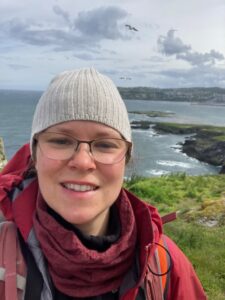 Alex Fink
Dr. Samuel Preston: “I’m a member of the ECSM team surveying cliff-nesting seabirds and ground-nesting gulls across several sites from Bray Head in Wicklow to the Skerries Islands in north Dublin. We conduct censuses and monitor breeding success to understand the populations better. Are they increasing or decreasing? Are they fledging enough young to maintain their numbers? And are they moving between sites? These data help inform conservation strategies for Ireland’s seabirds; a very important group for an island like ours.”
Ireland’s Eye: Gráinne Perryman and Aoibhinn Browne
This is the second year in which we’ve worked with Fingal County Council, the National Parks and Wildlife Service and Howth Castle Estate to warden the seabird colony on Ireland’s Eye, helping to ensure the seabirds are protected but that people can also enjoy the island. This work has been possible thanks to the Local Biodiversity Action Fund.
Gráinne Perryman: “I am a Marine Top Predator Ecologist and Marine Scientist with a particular interest in biologging research. In 2023 I worked in Gansbaai, South Africa, where I guided tours and collected data on many marine species like seabirds, waders, sharks and marine mammals. I then moved to Wales in 2024 to complete my MSc at Bangor University. My MSc thesis focused on investigating the influence of body size and ocean productivity on the foraging strategies of GPS-tagged shearwater species.
“In May 2026, I joined BirdWatch Ireland as a warden on Ireland’s Eye for the breeding season. Our main role is to monitor seabird disturbance. We have also had the opportunity to help census the island and collect productivity data on some of the seabirds. I am looking forward to seeing the chicks grow and fledge. The Gannet is my favourite seabird because of its beautiful colours, effortless gliding and impressive wingspan.”
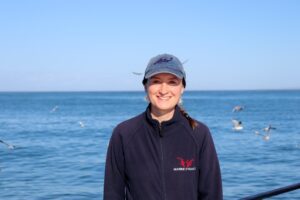 Gráinne Perryman
Aoibhinn Browne: “I’m a warden on Ireland’s Eye. We wardens are present on the island to monitor and help prevent disturbance to the breeding seabirds, as well as to talk to visitors on the island about the importance of reducing disturbance. We also contribute to censusing and productivity monitoring on the island with the East Coast census team.
“I’ve just completed a masters at ATU Galway, studying the diet composition of inland Lesser Black-backed Gulls, so my current favourite group of seabirds are gulls. And the island is currently full of Herring Gull and Great Black-backed Gull chicks, so I’m really enjoying watching them grow.”
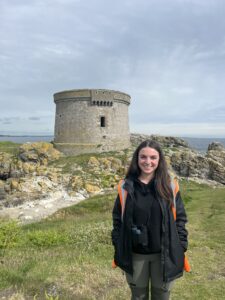 Aoibhinn Browne
Rockabill: Sophie Elliott, Hannah O’Connor and Jody Affleck
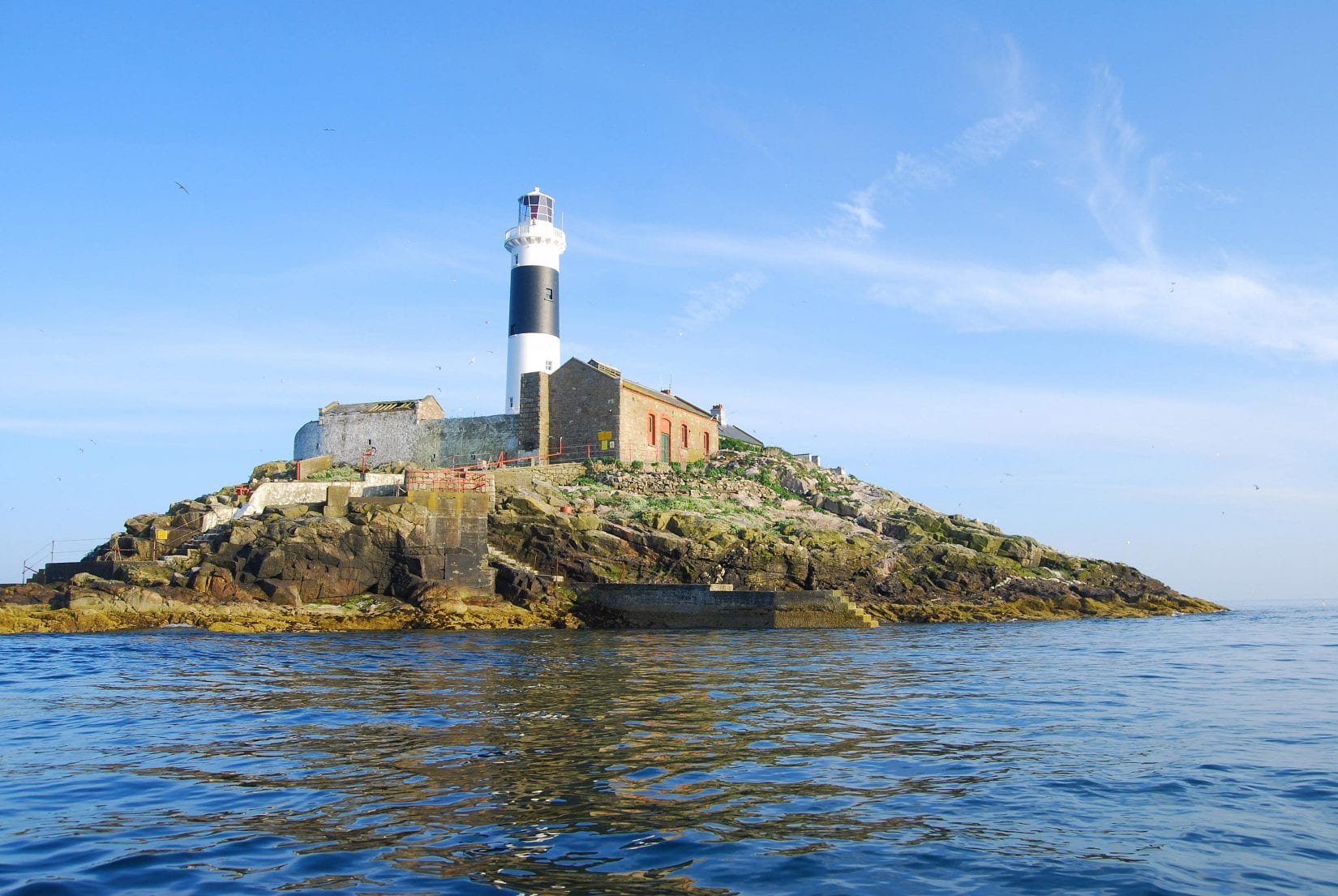
Rockabill Island in north Dublin hosts around 85% of the European population of Roseate Terns thanks to a lot of very hard work by BirdWatch Ireland and the National Parks and Wildlife Service since 1989. We’re delighted to continue working closely with NPWS this year to ensure the colony continues to thrive.
Hannah O’Connor: “Hi, I’m Hannah, one of the Rockabill wardens this year. I’m enjoying watching the Common Terns chatter and squabble, listening to the seals down by the pier and taking in the lovely sunsets so far this season on the Rock. I can’t wait to monitor and ring the fluffy Black Guillemot chicks!”
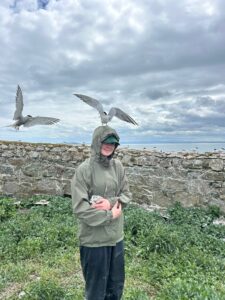 Hannah O’Connor
Sophie Elliott: I’m Sophie Elliott and I’m one of the Rockabill Island Seabird Wardens. This is my second season back on the Rock, and it has been very different this year so far!
“I have an MSc in Conservation Science from Imperial College London, and I have been working with seabirds around the world for over 10 years, conducting research, monitoring, hand-rearing and translocations.
“Seabirds are just the BEST! I love their noise, smell, feistiness and the truly stunning places they inhabit to breed. Our breeding seabirds on the Rock (terns, Kittiwakes, Black Guillemots etc) have just begun to hatch, and I’m so excited for the island to be covered in babies again!”
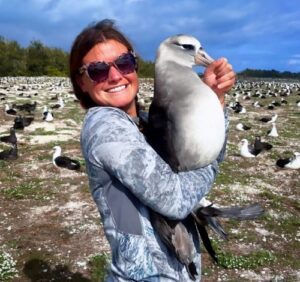 Sophie Elliott
Jody Affleck: “Hi, I’m Jody, one of the Rockabill Tern Wardens this season. After doing a Herring Gull colony-based masters’ thesis, I have fallen in love with seabird research and conservation. I have also been lucky enough to work on other seabird islands and I am excited to take on the challenge again.
“In my role, I live on Rockabill with two other wardens, monitoring and protecting the tern populations throughout the breeding season, along with the Black Guillemots and Kittiwakes. I’m really looking forward to getting more experience ringing the birds and seeing the little eggs grow into clumsy fledglings!
“My favourite seabird is the Shag, but I’m enjoying getting to know the Roseate Terns here on Rockabill.”
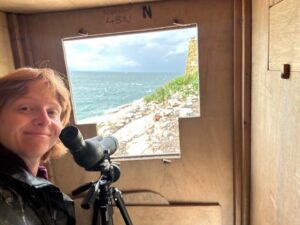 Jody Affleck
The summer is a very busy time at our seabird colonies and, in addition to these projects, we also have Mariona and John working on the NPWS tern conservation project at Lady’s Island Lake in Wexford, as well as our long-running conservation efforts at the tern colony in Dublin Port, funded by Dublin Port Company. Keep an eye on our social media, our website and upcoming issues of Wings magazine for more updates on our seabird work!