If we’ve learned anything from the droughts, wildfires and floods this summer, it’s that climate change is here, and it is going to impact all of us—humans and wildlife alike. We’re releasing a series of articles that look at seabirds and the effects of climate change on their behaviour and ultimate survival. When we say that for climate change the writing is on the wall, seabirds are one of the most important scribes of that message. There would be a good argument for replacing the canary in the coalmine with a seabird variation for the many ways they alert us to changes both beneath the surface of the ocean and in the skies, a dual function unique to them in the marine world. With that, here’s the first article of our climate and seabird series.
 Bottom Up
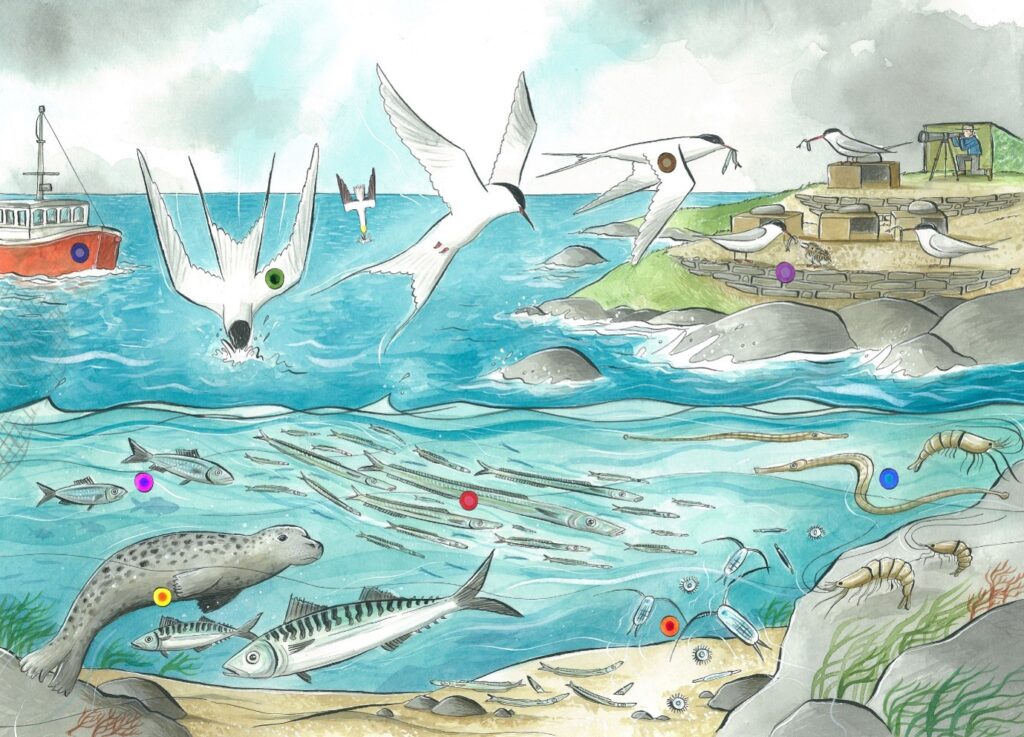
Food chains and complex food webs in the ocean, under pressure from climate change, are revealing problematic shifts that are wreaking havoc on once stable systems. One cohort feeling the effects of this more acutely than others are the world’s seabirds. Predictions point towards some seabird populations declining by over 70% by 2050 if conditions driving climate change remain untackled. Impacts on seabirds often occur through bottom-up processes. By deconstructing and discussing one simple food chain, we can begin to grasp how environmental drivers of climate change are affecting each individual link (trophic level) in the chain, from the microscopic right up to top predator seabirds.
At the origin of most food chains in the ocean are what are referred to collectively as the primary producers. This group includes tiny phytoplankton that rely on photosynthesis (just like green vegetation on land) for their food production and forms the basis of many food webs in our oceans. If you have ever added Spirulina to your morning smoothie, you too have added marine algae to your diet! Ireland’s seas are some of the most abundant waters thanks to phytoplankton.
Climate change is affecting primary production in complex ways, but a lot of it boils down to changes in the timing of when this vital food source is most abundant. Any breakdown in this synchronized production across a food chain is referred to as ‘trophic mismatch’. It is crucial that food is available in the right place at the right time. The impact of this depends on the ability of a predator to adapt relatively quickly to these changes. Their survival depends on it.
 Moving up the Chain
 Moving up the Chain
Many food chains follow the trend of ‘slightly bigger eats smaller’. This brings us next to zooplankton- a wide variety of tiny animal organisms including the larval stages of larger ones. More specifically, we will look at copepods. Still extremely small in size, these small crustaceans are a popular food source for a range of sea animals. They are vital to young fish in the early stages of development, and small foraging fish species in general. These inconspicuous organisms move up and down in the water column based on daylight hours. Zooplankton are affected by changes at primary production level and that essential timing of when phytoplankton is plentiful, as well as affecting zooplankton egg production.
With climate change, it is rarely just one cause and one effect. Copepod distribution and egg production is also impacted by oxygen levels in the water. Warm water rises to the surface because it is less dense (stratification), and cannot hold on to oxygen as well as colder water, so it escapes into the atmosphere. Quite annoying, as the phytoplankton previously discussed creates a huge amount of vital oxygen in the first place! In pockets of water devoid of enough oxygen, copepods are vulnerable to suffocation. Free-swimming animals such as fish can avoid these areas, but the more free-floating plankton simply do not have that luxury. As global warming continues, the scale of oxygen-deficient water is expected to expand and intensify. As important contributors to food webs, carbon sequestration and nutrient cycling, a collapse in zooplankton communities would have catastrophic consequences for marine life. What’s the solution? The temperature needs to come down, and fast.
With zooplankton moving up and down the water column (down by night and up by day) predators of zooplankton must also time their meals accordingly, assuming the zooplankton materialises where and when it should in the first place. Small foraging fish such as the sandeels are heavily dependent on zooplankton. Silvery, slender fish with a pointed snout, they can occur in very large shoals. Sandeels play an important role in a food chain as both predator and prey. Thoughts and prayers are with sandeel in making it through the day, because it seems like almost everything wants to eat them! These are small fish with a big impact on marine food webs. Sandeels are very vulnerable to changes in the distribution of copepods. Temperature fluctuations in the water can affect sandeel metabolic rates, impacting reproduction and survival. Recorded declines of copepod availability in the North Sea have directly impacted sandeel populations, with repercussions for predators further up the chain. The situation there is so dire that the International Council for the Exploration of the Sea (ICES) advised no fishing for sandeel in certain areas of the North Sea for 2026.
 A Crucial Link
 A Crucial Link
There still exists a significant gap in our understanding of this foraging fish. Very little is known about the recovery of sandeel in response to various threats. It is known that the average sandeel size in the North Sea has seen a reduction in the last three decades, meaning seabirds must work harder and catch more to make up for the size decrease. This is the seabird version of shrinkflation!
Seabirds very much rely on sandeel for a sufficiently calorific and nutrient-rich diet. The majority of Ireland’s seabird species include sandeel in their diet, with terns and auks being particularly dependent on this food source. This is understandable when you remember that some seabirds are much smaller than others, and none of them famous for chewing their food. They must swallow their prey whole, as is also the case for their growing chicks. Sandeel is an oily nutrient rich fish, so its hunter really gets bang for its buck with a sandeel diet. Occurring in dense shoals in shallow coastal waters, sandeels tend to dwell close to the seabed. Diving birds like auks are instrumental in driving the sandeel up closer to the surface, so surface-feeding birds like terns can pick them off with greater ease, a beneficial interspecies dynamic.
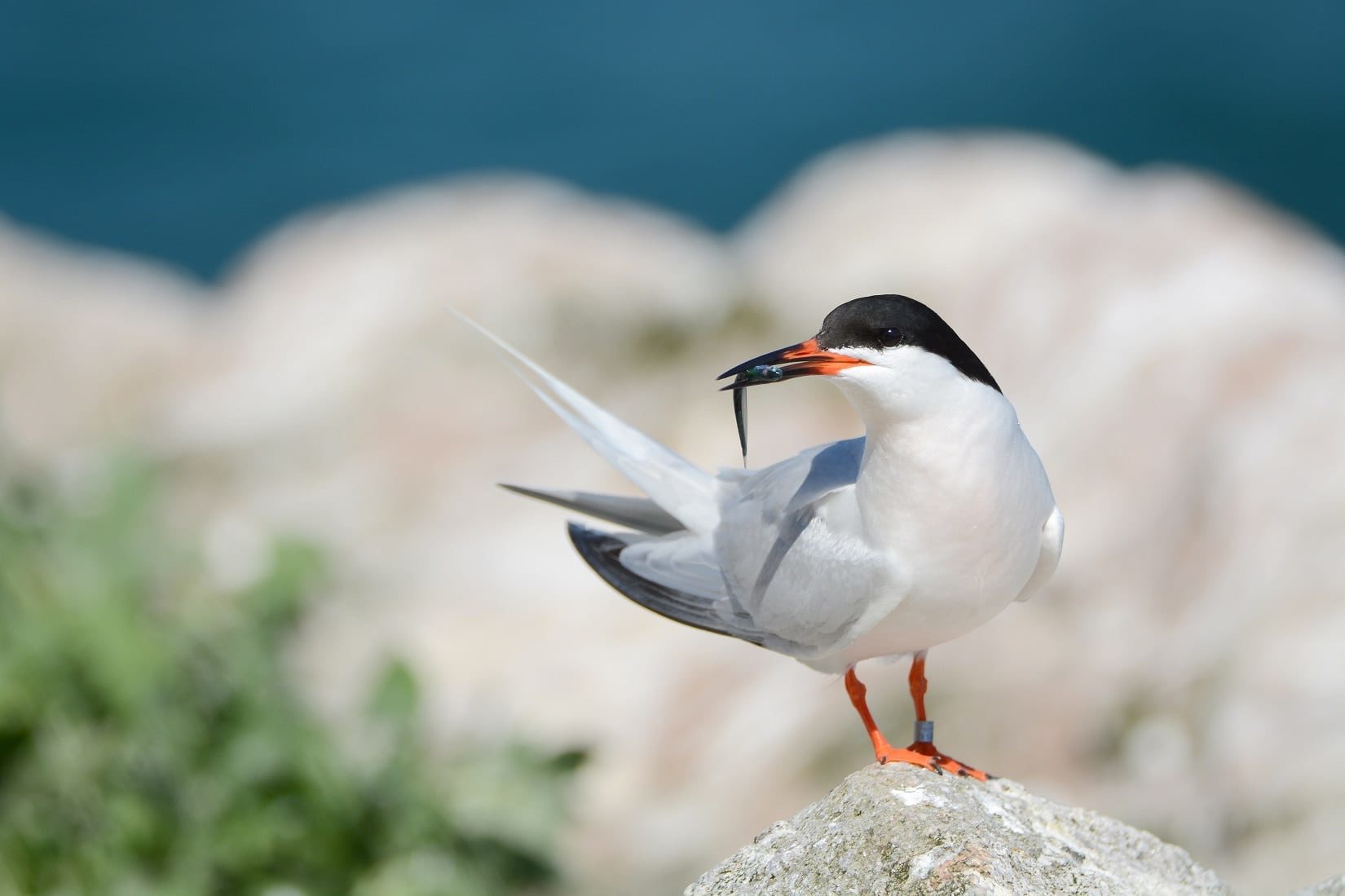
At the top of the food chain, competition between predators vying for the best food is fierce, with many other fish and marine mammals in the mix. Sandeels remain an important component of the diet of Roseate Terns on Rockabill for example, and Puffins on Lambay. In other European countries, sandeel is commercially fished to supply fish meal to fish farms and other animal feed industries. The United Kingdom has a ban on sandeel fishing in place since 2024 which is seen as a big step towards protecting seabird populations of global importance. In European waters however, tens of thousands of tonnes are still extracted annually. Consideration for the protection of this critical prey item when implementing and managing protected areas in our marine territory would go a long way toward alleviating some of the pressure on vulnerable seabirds in the face of climate instability. This would require a reduction in fishing pressure on sandeel along with restricting/removing harmful fishing. Seabed disturbing activities would have to be curtailed in important areas for the species such as sandbanks. If sandeel are to survive the pressures heavily impacting them from climate change, thereby securing a vital food source for seabirds, every opportunity must be taken to avoid adding to their woes.