
From roughly April to August, Ireland’s coastline transforms into a bustling and vibrant maternity ward for twenty-four species of seabird, with breeding colonies numbering from single digits into the thousands.
Flocking to Ireland
Move over Lisdoonvarna! The appeal of Ireland’s coastal landscape and climate for avian matchmaking is the real deal. By the time the town’s annual matchmaking festival comes around each September, the seabird summer of love has already been and gone. Funny that just a few miles away from the town itself are the Cliffs of Moher, a stretch of sheer cliffs stretching several kilometres that host so many seabirds each nesting season that the cliffs resemble a packed Croke Park on match day. Approximately 50,000 Kittiwakes, Guillemots, Razorbills and Puffins come together to transform the cliffs into one giant nursery, as well as almost 10,000 Fulmars, Herring Gulls, Shags, and Great Black-backed Gulls. Looking at such a concentration of feathered visitors, it is difficult to contemplate the daunting reality of climate change and what it means for their future here and indeed anywhere.
When discussing the various environmental drivers impacting seabirds, time and time again it will ultimately come back to a bird’s ability to carry out the most essential of life’s tasks- feed and breed. In Ireland and indeed globally, the Black-legged Kittiwake stands out as one of our seabird species under significant pressure from more than one indicator of climate change. You might be alarmed to learn that at the Cliffs of Moher Kittiwake numbers are in fact down by almost half compared to the previous count, and for Puffins the picture is starker, with an 88% drop between counts. The national and global trends are mainly attributed to climate change, predation and severe weather, further exacerbated by commercial fishing activities competing for key prey species.
Parenting Woes
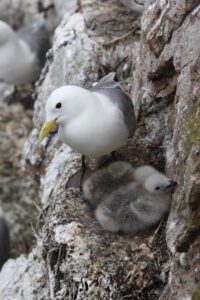
Kittiwakes are quite unfortunate to have characteristic routines and requirements that are negatively impacted by global warming, and each requires a degree of adaptation. Not all adaptation may be within a Kittiwake’s control when facing both the direct and indirect effects of climate change. Whether it’s trouble finding and catching enough food (indirect) or successfully locating a suitable nesting site, incubating eggs and keeping chicks safe from prolonged extreme heat or severe storms (direct), the challenges are many. Each year, Kittiwake populations run the gauntlet of climate pressures that they either survive or succumb to, and this will have a knock-on effect in the years to follow.
Like most seabirds that live a long time, Kittiwakes have a typical life expectancy of around 12 years (though the oldest ringed bird was 28 years old) and are relatively slow to reproduce, maturing at 4 years and producing 1 or 2 eggs each breeding season, if they’re lucky. Not a great start for any top predator trying to get ahead of accelerating climate change. It’s very much strength in numbers, so animals that produce more offspring more frequently have the upper hand. Kittiwakes are known to be somewhat monogamous, often reuniting with a mate from the previous season, and this increases the likelihood of returning to a nest that they both liked. Kittiwake males are more loyal to the nesting site where they were born, something Irish mammies can perhaps relate to.
Tough Choices
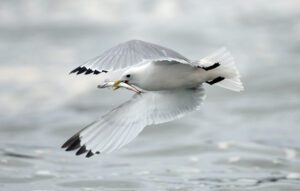
The breeding distribution of Kittiwakes is within the more northerly latitudes at both sides of the Atlantic Ocean. Far from being lackadaisical about where to raise their young, Kittiwakes carefully choose sites (predominantly steep cliffs) that account for such things as sun and rain exposure, wave action, protection from predators, and proximity to their food supply. However, pairs also return to sites where they were previously unsuccessful in fledging a chick or two or victim to predation, which could be down to inexperience or limited alternative options. A reluctance to give up a familiar spot and undergo the risky Goldilocks routine again is understandable. However, with every bad experience, Kittiwakes in some way must be having that internal discussion “Should I stay or should I go?”, with some populations adjusting their range and some adjusting their diet in order to cope with the challenges, be they food or temperature related. Rising sea temperatures are affecting the timing and availability of key fish species that seabirds depend on, and the resulting stratification within the water column creates further difficulty in catching prey, particularly for surface-feeders like Kittiwake. With stratification, there is a pronounced difference in temperature between shallow and deeper water, as well as with salinity (how salty the water is) and light availability. Appreciating how this can greatly affect plankton growth and therefore fish occurrence and growth, this has immediate consequences for breeding success. Strong, early stratification negatively impacts kittiwake breeding success. There is evidence to suggest that the extent of impacts of climate change on Kittiwake varies depending on their geographical location, which presents a small glimmer of hope for the time being until more is understood. For example, Celtic Sea populations may benefit more than their more northern Scottish counterparts from a better selection of prey fish species, such as sprat and herring, which are not affected by temperature in the same way sandeels are.
Kittiwakes are categorised as ‘Vulnerable’ by the International Union for the Convention of Nature (IUCN) due to rapid declines globally over the last three generations and are currently one of four red-listed seabird species in the Birds of Conservation Concern in Ireland assessment due to the rate of decline and the level of concern that it presents. Conservation efforts for Kittiwake are harder to devise than for other seabird species. One recommendation has been to identify indicator seabird species to study at regional sentinel sites, and in Britain the Kittiwake is one such species.
What will the future hold for breeding seabirds in Ireland? Will many of our birds abandon ship for cooler northern climes? Will we become a refuge for birds escaping other regions no longer providing sufficient shelter or sustenance? Will impacts on food supply make their plight ultimately unbearable? In understanding and recognising our potential losses and gains in the face of climate change, every avenue for action to stall and reverse human-induced climate change must be explored.