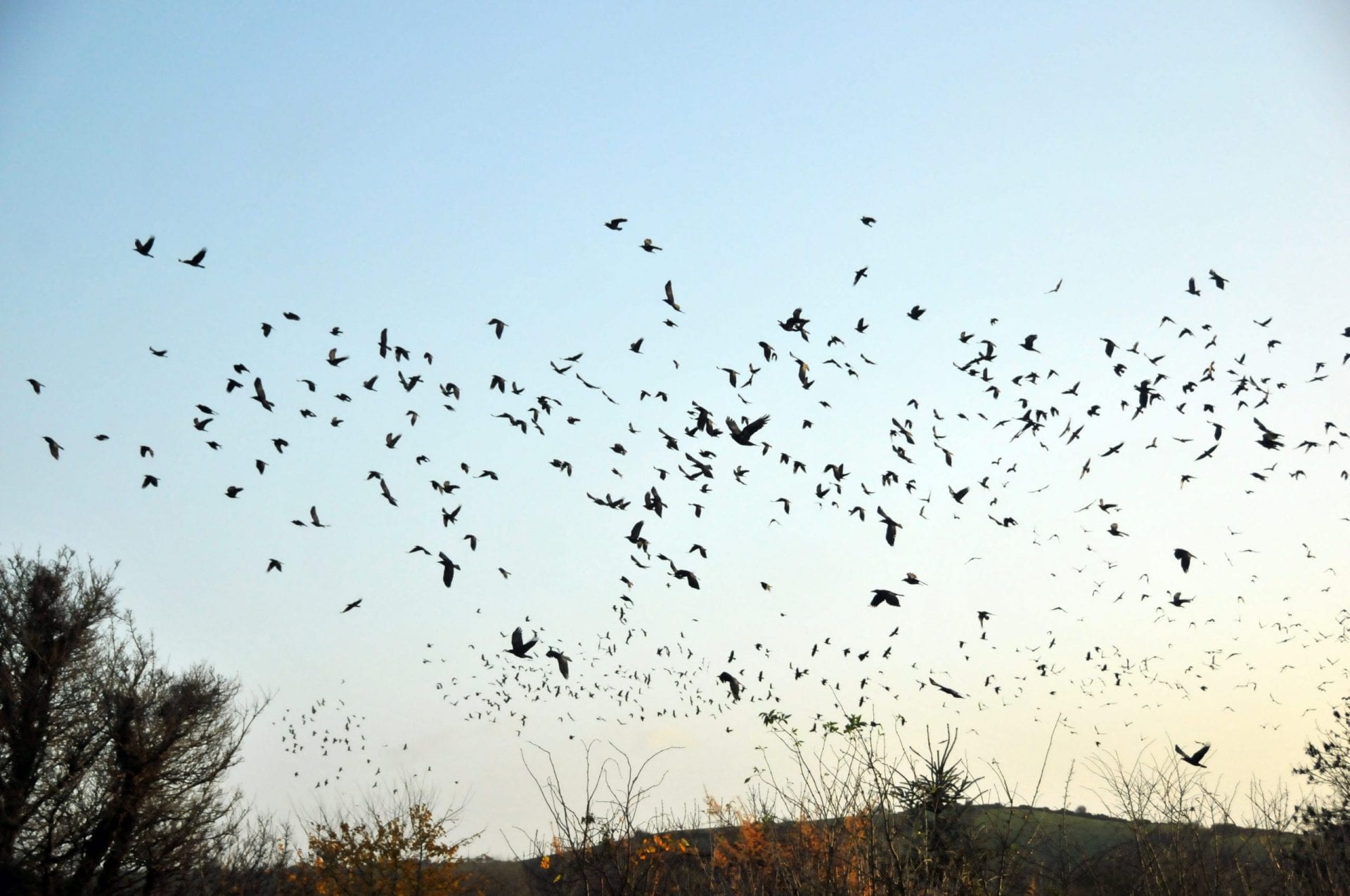
Maybe it’s the Raven’s ominous ‘Nevermore’, the attacking crows in Alfred Hitchcock’s The Birds, or the fact that a flock of crows is called a ‘murder’ — no group of birds quite encapsulate Halloween like Corvids. Although Corvids don’t deserve the bad rap they are given, their curious behavior and haunting caws don’t help their case in the court of public opinion. Instead of feeling haunted by your neighborhood Magpie this spooky season, learn more about some of our common Irish Corvids and how to tell them apart.
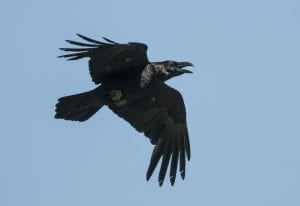 Raven
As our largest songbird, Ravens are slightly larger than Buzzards. Adults show an all-black, glossy plumage with shaggy throat feathers. They have thick, black beaks that help their varied diet. Like other members of the crow family, Ravens are incredibly intelligent and have been known to engage in playful behaviour, such as flipping upside down with closed wings. They are social birds, and young Ravens can be found roosting together in large groups during the winter. In flight, they can be identified by their wedge-shaped tail. Bonus fact, Ravens often only have one mate for life!
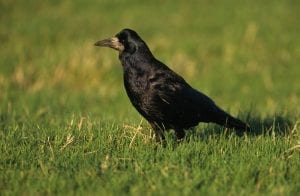
Rook
Besides being smaller than a Raven, a distinctive clue to identifying adult Rooks is the bare, pale base of the bill and shaggy feathers on the thighs that makes them appear to have trousers. Rooks are one of Ireland’s most common birds and can be seen across the island, nesting in noisy colonies called rookeries. When separating Hooded Crows and Rooks in flight, Rooks have faster and deeper wingbeats, which makes it look as if they are making more effort than the Hooded Crow.
 Hooded Crow
 Hooded Crow
s may be one of the easiest crows to identify, thanks to their unmistakable grey body and black head, throat, wings, and tail. These crows are also incredibly intelligent and have been recorded using crafty methods to crack open nuts, such as placing the nut on the road and waiting for a car to break the shell.
…
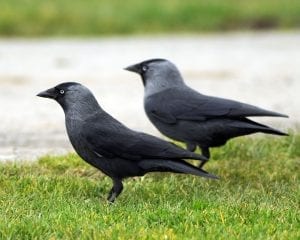 …
Jackdaw
Smaller than the other species here, the Jackdaw has a short black bill and a pale, silvery eye. Like the Hooded Crow, Jackdaws have a black and grey contrast between the head and throat, but it is much less drastic. They are widespread across Ireland, but are less common in the mountainous areas of the west. During roosting season, Jackdaws can be found in the company of other crows, especially Rooks. They practically say their own name with the sharp ‘chack’ of their call.
Magpie
 Magpie
And, of course, no Irish Corvid list would be complete without the Magpie. Unlike the other species listed above, Magpies have a splash of colour in their plumage. Their head, chest, back, and tail are black while their belly and flanks are white. In the right light, you can discern a green and blue gloss on their wings and tail. Juvenile birds are very similar to adults but lack the long tail, which takes a while to grow!